Cedar Roof Repair
Clear judgment. Targeted work. No unnecessary disruption.
What It Really Means
A Slip, a Split, or a Leak—We Provide Clarity.
Most homeowners seek repair because something on their cedar roof catches their eye: a slipped shingle, a thinning or splitting area, or a ridge cap loosened after a storm. Sometimes the issue feels more urgent, such as a water stain after heavy, wind-driven rain. Chances are, the issue is easy to diagnose.
Contact us and we’ll take a look and give you clear answers.
Get Clarity
The first step is understanding what you’re looking at and what it does or doesn’t mean for the health of your roof. Every cedar roof tells a story. A clear evaluation gives you real clarity and helps you make the right decision with confidence.
Why Precision Matters
The Strength of Your Cedar Starts at the Exposure.
The exposure—the visible portion of each shingle—takes the full impact of sun, weather, and moisture. Over time, cedar dries out, thins, and begins to move—a shift that brings consequences of its own. As movement develops, the wood reacts: splitting, cupping, and curling as the roof ages.


What We Evaluate And Why It Matters
A proper cedar roof evaluation focuses on three critical factors:
How much strength remains in the shakes or shingles in the area being considered for repair.
The type, length, thickness, and condition of the wood, including the underlayers.
Whether replacing a shingle will improve the area—or risk harming the surrounding wood.
But appearance alone doesn’t tell you whether a repair makes sense. What truly matters is the condition of the exposed wood—is it strong enough to accept a repair without causing unintended damage to the surrounding shingles?
Once these factors are understood, the right repair decision becomes clear.
The Repair Philosophy: When to Act
Judgment Matters: Why Cedar Repairs Are Delicate.
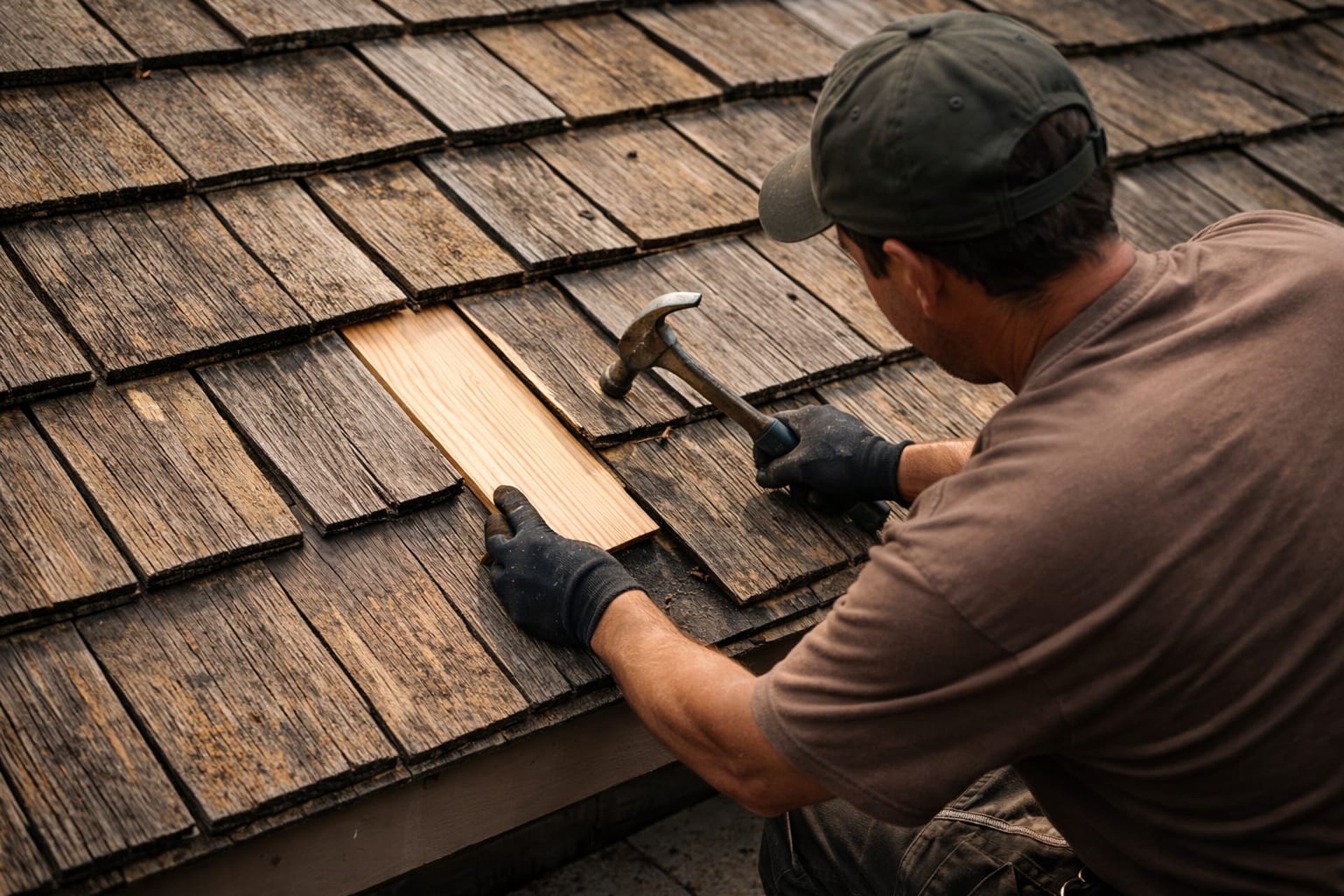
Replacing a cedar shingle isn’t simple. Each piece is fastened through the exposure into layers below. Those nails are buried—not visible—and removing one shingle means breaking or cutting six nails driven through the underlayers.
On strong, healthy wood, this can be done cleanly.
On thin or brittle late-life sections, the same force can crack or fracture surrounding shingles.
Necessary, Beneficial, Structurally Appropriate
When evaluating an older cedar roof, we’re often looking for reasons not to repair. Many areas that appear aged are still performing exactly as they should.
A proper evaluation ensures any repair we recommend is:
Necessary
Beneficial
Structurally Appropriate
What begins as a small cosmetic fix can become unnecessary disruption. That’s why judgment matters. A roof that’s still functioning—even if it looks rough—is often better left alone unless a true leak or failure exists.
Our Repair Methods: Controlled and Precise
How a Cedar Repair Is Done: Controlled, Precise, and Purposeful.
When a repair is appropriate, it is controlled and deliberate. Our process involves:
Removing only the failing piece.
Working carefully around surrounding wood.
Breaking nails as cleanly as possible using proper tools.
Fitting the new shingle so the system continues performing without unnecessary disturbance.
Late-Life Roofs: When a Metal Shim Is the Smartest Approach
On older roofs nearing the end of life but still shedding water, metal shims are often the smartest option. A shim offers a low-impact solution that avoids prying apart fragile late-life wood:
It slides beneath the exposure.
It reinforces a soft spot.
It redirects water.
It stops a developing leak.
It’s low-impact, effective, and aligned with the true condition of the system.
A cedar repair isn’t about making the roof look new. It’s about restoring strength where it’s needed and keeping the rest of the system undisturbed.
Conclusion: Planning Practical Next Steps
When a Repair Adds Little Value: Focus on Function.
Cosmetic repairs rarely add meaningful life to a late-stage cedar roof.
Why we advise caution on cosmetic fixes:
Split or curled pieces often still protect just fine.
Replacing them means disturbing surrounding older wood.
New shingles stand out sharply against weathered cedar.
The disruption rarely adds years to the roof.
Cedar Roofs Rarely Fail Suddenly—They Fade Out.
Cedar roofs are rarely replaced because they suddenly stop working. They are typically replaced because: the exposure looks worn, the roof sheds pieces, the home’s appearance suffers, and the cost of replacement becomes unavoidable.
Repairs are not what extend the life of an older cedar roof. Good evaluation, smart timing, and knowing when to leave the wood alone do.
In many late-life cases, the better approach is to: monitor the area, avoid disturbing functioning wood, use shims when needed, and plan practical next steps.
Gain Confidence in Your Roof's Condition.
Don't guess what your cedar roof needs. Let our judgment and precision guide you to the smartest,
Ready to keep your cedar roof strong and protected?
Schedule your evaluation and we’ll assess the roof, explain what it needs, and guide you toward the right next step. Call anytime, or use our quick form if you prefer to schedule after hours.
Gallery


Care Built on Judgment You Can Trust.
Address
180 West main St. Pottstown, pa. 19465
Fastest way to reach us
Contacts
contact@cedarpreserve.com
610-340-5411
Opening hours
Monday - Friday: 9:00 - 5:00
Saturday: 9:00 - 16:00
Sunday: Closed
Get your roofing project moving! Provide a few details below and our team will reach out with the information you need. We’ll follow up by text.