Why Cleaning Alone Can Accelerate Cedar
And How Preservation Solves the Problem Cleaning a cedar roof removes its natural surface buffer. Without preservation, sun and moisture accelerate aging, thinning, and long-term damage.
– Read more –
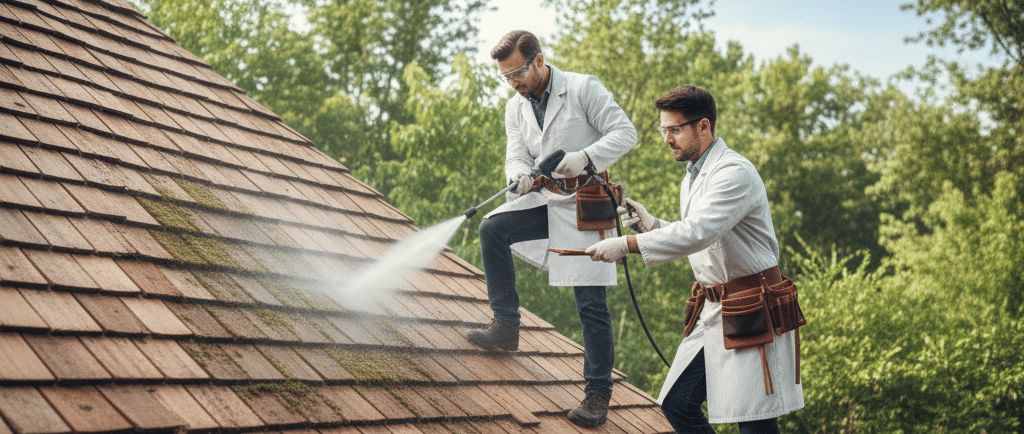
Cleaning a cedar roof removes mold, mildew, and the thin layer of sun-weathered cedar fibers on the surface.
What most homeowners don’t realize is that these elements also form a natural shade layer — a surface buffer the roof builds gradually over time. This layer softens how directly the wood reacts to sunlight and moisture. It isn’t true protection, but it does slow exposure while the roof is young.
When that layer is removed through cleaning, the cedar is left exposed in a way it hasn’t been since installation — but without the natural oils it once had to protect it.
In many ways, the wood is now more vulnerable than it was on day one.
That’s where preservation becomes essential.
1. After Cleaning, Sunlight Hits the Cedar Directly
Without the surface shade layer, ultraviolet light reaches fresh cedar immediately. The wood begins reacting again to its two greatest stressors: sunlight and moisture.
Cleaning may make the roof look refreshed, but without preservation, it places the cedar into a faster aging phase — one that many homeowners don’t notice until years later.
2. Moisture Movement Becomes More Aggressive
Freshly cleaned cedar absorbs and releases moisture more quickly.
Combined with direct sun exposure, this accelerates the expansion-and-contraction cycle that leads to:
Cupping
Curling
Splitting
Early thinning of the exposure layer
Cleaning itself isn’t the risk.
Leaving the wood bare afterward is.
3. Cleaning Alone Leaves the Roof Underprotected
A cedar roof functions as a layered system.
Cleaning removes the working surface of the exposure layer — the roof’s first line of defense — while the deeper layers remain dry and unconditioned, relying entirely on that outer surface for protection.
The roof may look clean, but it is often underprotected far longer than homeowners expect. Without preservation, it can take years for cedar to rebuild a natural surface buffer. During that time, the wood typically ages faster than it otherwise would.
How Preservation Solves the Problem
Preservation replaces the temporary, weathered surface layer with something far more effective:
a deeply penetrating, purpose-built treatment designed to stabilize and protect cedar.
Applied after cleaning, preservation:
✔ Creates a UV-shielding barrier
More consistent and longer-lasting than the natural weathered layer ever was.
✔ Reconditions the wood
Restoring lost oils in a controlled, uniform way.
✔ Slows moisture movement
Helping water stay on the treated surface instead of cycling rapidly through the wood.
✔ Prevents post-cleaning accelerated aging
Allowing the roof to settle into a slower, more predictable aging curve.
✔ Strengthens the exposure layer
When the top layer is stable, every layer beneath it benefits — structurally and visually.
Preservation also protects the roof’s appearance, maintaining the natural look homeowners value most.
In Short
Cleaning prepares the cedar.
Preservation protects it.
Do one without the other, and the roof ages faster.
Do both — in the right order — and the roof gains years of stability, performance, and beauty.
Address
180 West Main St. Pottstown, PA. 19465
Contact
Hours of Operation
Monday - Friday: 9:00 am - 5:00 pm
Saturday: 10:00 am - 2:00 pm
Sunday: Closed